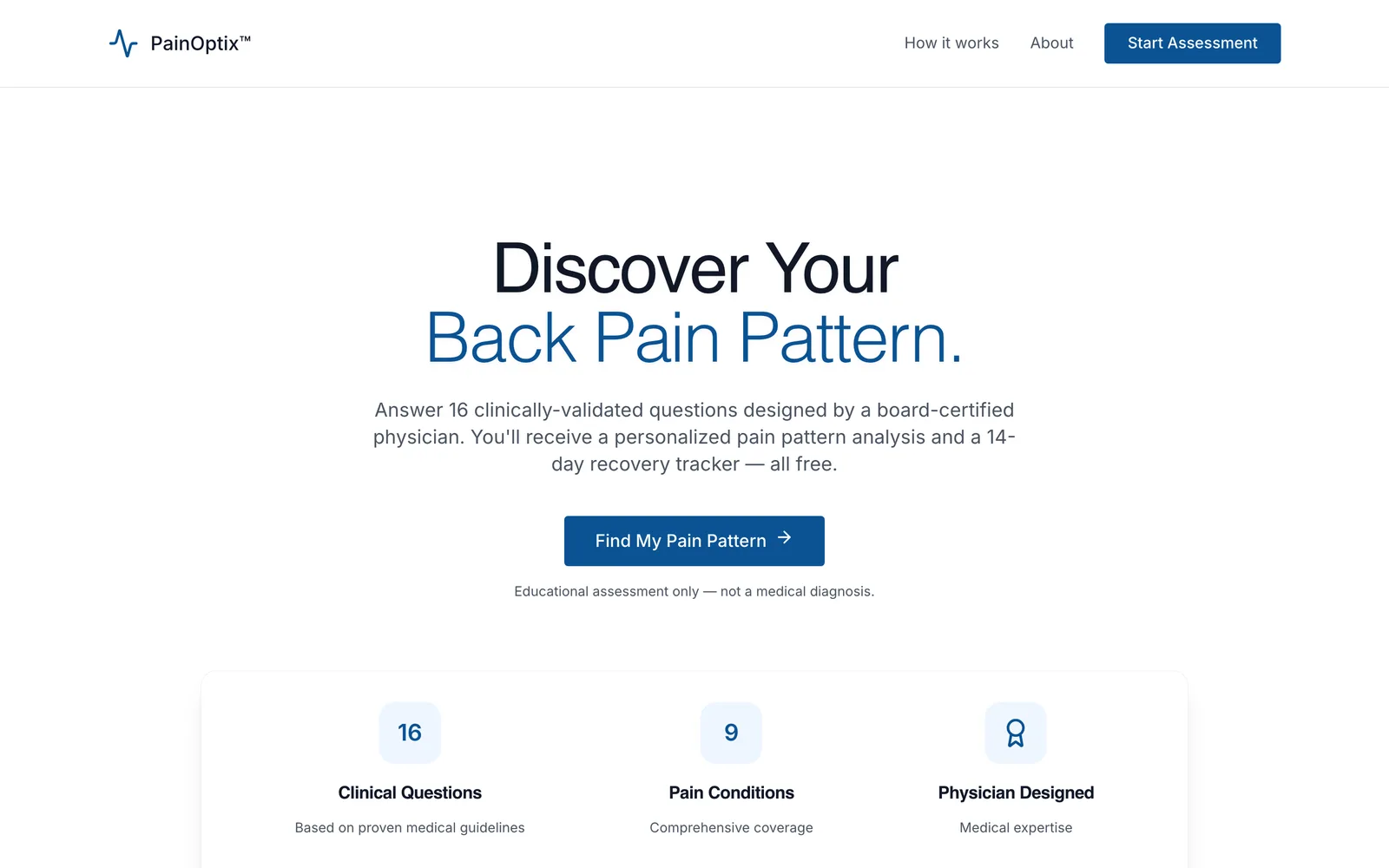
PainOptix — Clinical Decision Support for Pain Management
A real healthcare software engagement built around daily clinical use, ongoing retainer work, and a careful architecture that keeps personally identifiable patient data out of the application database.
PainOptix is not a one-off concept build. It is an active healthcare software engagement that has continued on retainer and evolved based on real use inside the practice.
Decision support, follow-up workflows, and clinical tooling built to fit an existing practice instead of replacing it.
Clinical usage by an active pain management practice since 2025.
Ongoing development relationship driven by real workflow needs.
Patient identifiers remain in the EHR rather than the application database.
The physician needed faster decision support without creating a data mess.
Pain management involves repeated decisions that depend on diagnosis history, symptoms, medication interactions, procedures, and longitudinal patient outcomes. In practice, that can mean a lot of manual cross-checking while time is already limited.
The challenge was not just building a smart tool. It was building one that supports the clinical workflow without introducing unnecessary data risk, documentation burden, or another system the physician has to fight with.
A practical clinical system designed to work alongside the existing EHR.
PainOptix provides decision support through a deterministic treatment-logic layer, follow-up communication workflows, and supporting documentation tools. It is intentionally designed to complement the physician’s existing process instead of pretending to be a full EHR replacement.
One of the most important design decisions was the air-gap model: the app works with anonymized research IDs, while patient identifiers remain in the EHR. That keeps the software useful in practice while avoiding the worst kind of overreach in a sensitive environment.
This is the kind of higher-trust software work WestchesterAI can support carefully.
PainOptix matters because it proves WestchesterAI can work inside more serious, higher-trust workflows when the scope is right and the architecture is handled responsibly. The lesson is not that we should promise any compliance-heavy build. The lesson is that we can support real operational software if we scope it carefully and build with discipline.
It also shows the value of retainer-based product development. The software continues to evolve from real-world use instead of being frozen at the moment it launches.
Responsible scope and architecture matter more than flashy claims in healthcare software.
PainOptix is valuable proof for WestchesterAI because it shows we can contribute to real healthcare workflows without pretending to be something we are not. The right way to approach sensitive work is narrower scope, stronger architecture, and honest boundaries.
ImmunaPath
Personalized cancer vaccine navigation platform. Helps patients and families understand and access the emerging world of neoantigen cancer vaccines and clinical trials.
ShowFloor.ai
AI visualization tool for flooring contractors. Upload a photo of any floor, choose a coating style, and see a photorealistic preview in seconds.
PermitBeam
Weekly building permit and violation digest for New York City insurance agents, adjusters, and contractors. Aggregates real-time data from four NYC Department of Buildings sources — new permits, active violations, complaints, and inspections — filtered by ZIP code and delivered every Monday.
Need a higher-trust tool built carefully?
We can help with selected operational software, decision support, and workflow tools when the scope is clear, the architecture is responsible, and the expectations are honest.